
Manufacturing centres are under increasing pressure to improve productivity, reduce downtime, monitor energy usage, maintain quality, and make better operational decisions. However, many factories still rely on legacy machines that were designed long before cloud platforms, dashboards, predictive analytics, and connected monitoring became common. These machines may still perform their core production tasks reliably, but they often provide little or no digital visibility into how they are operating.
Replacing legacy machinery with modern connected equipment is expensive, disruptive, and often unnecessary. In many cases, the smarter approach is not to replace the machine, but to make the existing machine digital. This is where retrofittable IoT sensors provide a strong advantage.
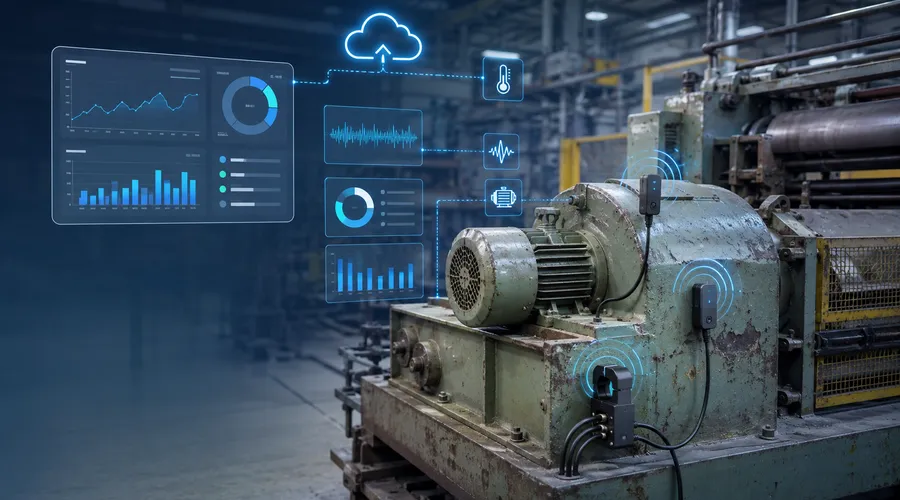
Retrofittable IoT sensors allow manufacturers to connect existing machines, assets, and production areas to a digital monitoring platform without changing the original machine control system. Sensors such as current sensors, temperature sensors, vibration sensors, air quality sensors, flow sensors, and environmental monitoring devices can be added externally or semi-invasively to collect useful operational data. This data can then be transmitted to a dashboard where teams can monitor performance, detect issues, identify trends, and make informed decisions.
PLC Sensors Are Designed for Control, Not Always for Wider Monitoring
PLC-based sensors play an important role in manufacturing environments. They are commonly used for machine control, automation, safety interlocking, sequencing, and real-time process operations. In applications where immediate control response is required, PLC-connected sensors are still essential.
However, PLC sensors are not always the best solution for broader operational monitoring, especially when the objective is to collect data from multiple machines, compare performance, track utilisation, monitor energy usage, or connect older equipment to modern cloud dashboards. Adding new sensors directly into a PLC system often requires machine downtime, panel modification, electrical integration, programming changes, safety checks, and validation work. For legacy machines, this can quickly become costly and complex.
In many manufacturing centres, the PLC is also dedicated to machine operation. It may not have spare input capacity, modern communication interfaces, cloud connectivity, or the flexibility required for additional monitoring use cases. Even when the data is available within the PLC, extracting it into a usable dashboard or analytics platform may require additional gateways, licensing, software development, or integration with existing SCADA systems.
This makes PLC-based monitoring suitable for control-critical operations, but less convenient when the goal is fast, scalable, and non-disruptive digital visibility.
Why Retrofittable IoT Sensors Are Better for Monitoring
Retrofittable IoT sensors are designed to solve a different problem. Instead of controlling the machine, they observe the machine. They can be installed on or around existing equipment to monitor current draw, vibration, temperature, environmental conditions, air quality, machine status, utilisation, and other performance indicators.
The main advantage is that these sensors can often be added without interfering with the machine’s existing PLC, wiring, warranty, or control logic. A current sensor can detect when a machine is running, idle, overloaded, or consuming abnormal power. A temperature sensor can monitor overheating, process stability, or cold storage conditions. A vibration sensor can help identify early signs of mechanical wear, imbalance, bearing issues, or misalignment. Environmental sensors can monitor the surrounding conditions that may affect product quality, operator comfort, or equipment reliability.
Because these sensors are independent from the machine control system, they can be deployed faster and with lower risk. They do not need to replace the PLC or interfere with safety-critical automation. Instead, they create an additional monitoring layer that sits above the existing machine infrastructure.
This is especially valuable for manufacturers with mixed equipment: old machines, newer machines, imported machinery, manual stations, semi-automated systems, and equipment from different suppliers. A retrofittable IoT system can create a common digital layer across all of them.
Turning Legacy Machines into Digital Assets
A legacy machine may not have Ethernet, cloud connectivity, built-in monitoring, or data logging. However, with retrofittable sensors, that same machine can start producing useful digital data.
For example, a simple current sensor fitted to the machine supply line can show when the machine is running, stopped, idle, or under load. Over time, this data can be used to calculate machine utilisation, operating hours, energy usage, production patterns, and abnormal behaviour. This allows a machine that previously had no digital output to become part of a connected manufacturing dashboard.
A temperature sensor can help monitor motor heating, enclosure temperature, process temperature, or storage conditions. A vibration sensor can provide early warning of mechanical degradation. A flow sensor can monitor compressed air, coolant, water, or gas usage. Environmental sensors can monitor CO₂, particulate matter, VOCs, humidity, and temperature across the production environment.
When these sensors are connected to an IoT platform, the factory gains real-time visibility. Operators, engineers, maintenance teams, and managers can view machine behaviour, compare assets, receive alerts, and make better decisions based on actual operating data rather than assumptions.
This is the practical meaning of digital transformation in manufacturing: not replacing every machine, but extracting useful data from the machines that already exist.
Lower Downtime and Faster Deployment
One of the biggest barriers to digitalisation in manufacturing is downtime. Any change to a production machine must be carefully planned because downtime affects output, schedules, and cost. PLC integration usually requires access to the electrical panel, wiring changes, software modification, testing, and sometimes specialist support from the machine supplier or automation contractor.
Retrofittable IoT sensors reduce this barrier. Many sensors can be installed externally, clamped around cables, mounted near motors, fixed to machine frames, or placed within the production environment. This makes deployment faster and less disruptive.
For manufacturing centres with multiple machines, the difference is significant. Instead of carrying out complex PLC modifications for every machine, a standard IoT sensor package can be installed across different assets. This allows companies to begin monitoring quickly, prove the value of the system, and scale gradually.
Better for Mixed and Older Manufacturing Environments
Many factories do not operate with one generation of machinery. A typical manufacturing centre may have equipment purchased over several decades. Some machines may have modern PLCs, while others may be manually operated or based on older control systems. Some may have proprietary controllers that are difficult to access.
This creates a major challenge for digital monitoring. PLC-based integration may work well for one machine but not another. Each machine may require a different communication protocol, software licence, data format, or integration method.
Retrofittable IoT sensors solve this by standardising the monitoring layer. The sensor does not need to understand the machine’s internal control system. It only needs to monitor the physical or electrical behaviour of the asset. This makes it possible to bring different types of machines into one dashboard, even if they come from different manufacturers or different eras.
A CNC machine, compressor, pump, mixer, chiller, packaging machine, oven, fan system, conveyor, or manual workstation can all be monitored using the same basic IoT approach. This gives manufacturers a unified view of operations without needing to rebuild the factory control architecture.
From Monitoring to Optimisation
The real value of retrofittable IoT sensors is not only in collecting data, but in converting that data into operational insight.
Once machine data is available, manufacturers can begin answering important questions:
Which machines are running most often? Which machines are idle for long periods? Where is energy being wasted? Which assets show abnormal operating behaviour? Are machines overheating? Are there signs of mechanical wear? Are environmental conditions affecting quality or comfort? Can maintenance be planned before failure occurs?
This creates a path from basic monitoring to optimisation. The first step is visibility. The next step is analysis. Over time, the same data can support predictive maintenance, energy optimisation, utilisation tracking, compliance reporting, and operational improvement.
For example, if a current sensor shows that a machine is powered but not producing for long periods, this may indicate inefficient scheduling or unnecessary energy consumption. If vibration data gradually increases, it may indicate a developing mechanical issue. If temperature rises above normal operating limits, maintenance teams can investigate before a breakdown occurs.
This allows manufacturers to move from reactive maintenance to proactive decision-making.
Retrofittable Sensors Support, Rather Than Replace, PLC Systems
It is important to understand that retrofittable IoT sensors do not need to replace PLC sensors. Instead, they complement them.
The PLC should continue to handle real-time control, machine logic, interlocks, automation sequences, and safety-critical functions. The IoT sensor layer should focus on monitoring, visibility, analytics, alerts, reporting, and long-term operational improvement.
This separation is useful because it keeps the machine control system stable while still allowing the manufacturer to benefit from modern digital tools. The factory gains new data without increasing the complexity or risk within the machine’s control system.
In this way, retrofittable IoT sensors act as a bridge between traditional manufacturing equipment and modern Industry 4.0 platforms.
A Practical Use Case: Machine Utilisation Monitoring
Consider a manufacturing centre with several legacy production machines. The machines are mechanically reliable but provide no digital data. Managers know when production is completed, but they do not have clear visibility of how long each machine runs, how much energy it consumes, or how often it is idle.
By installing retrofittable current sensors on each machine, the factory can immediately begin monitoring operating status. The system can detect whether each machine is off, idle, running, or under higher load. This information is sent to a central dashboard where the team can view machine utilisation in real time.
Over several weeks, the data may reveal that some machines are underused, some are left running unnecessarily, and some consume more energy than expected. Maintenance teams may also identify abnormal load patterns that suggest wear or process issues.
Without replacing the machines or modifying the PLCs, the manufacturer now has a digital view of machine behaviour. This data can support better production planning, maintenance scheduling, energy management, and investment decisions.
Conclusion
Retrofittable IoT sensors provide a practical, scalable, and cost-effective route for manufacturing centres to digitalise their existing equipment. While PLC sensors remain essential for control and automation, they are not always the most efficient solution for wider monitoring, analytics, and cloud-based operational visibility.
By adding independent IoT sensors to legacy machines, manufacturers can unlock real-time data without major disruption. Existing machines can become digital assets. Older equipment can be connected to modern dashboards. Maintenance teams can detect problems earlier. Managers can understand utilisation more clearly. Energy waste can be reduced. Operational decisions can be based on real data rather than guesswork.
For many manufacturing centres, the future of digital transformation does not begin with replacing legacy machines. It begins with retrofitting them with intelligent sensors and turning them into connected, data-generating assets.