
Challenge
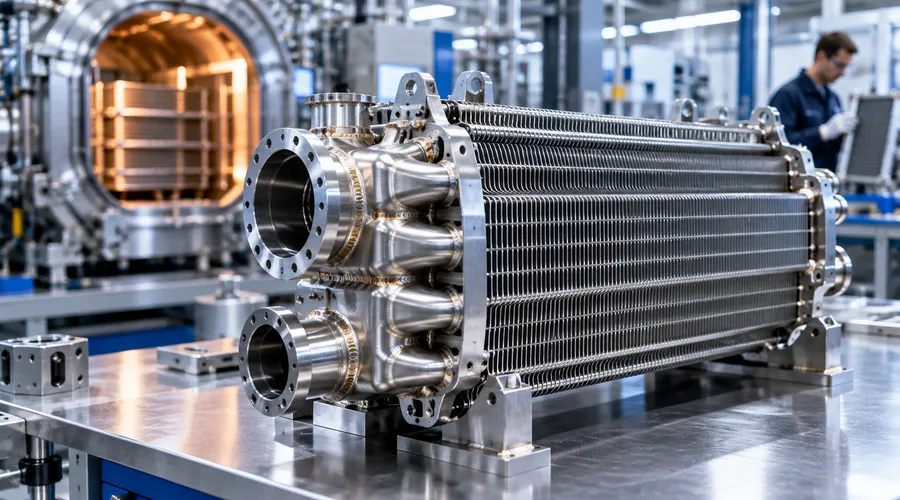
Manufacturing heat exchangers for aerospace applications requires exceptional precision, process consistency and adherence to stringent quality standards. For a global heat exchanger manufacturer, variability across critical production processes, including brazing, heat treatment and leak testing, was affecting first-pass yield, increasing rework and extending development timelines.
Variations in furnace temperature profiles, fixture loading and cooling rates made it difficult to maintain consistent brazing quality and component integrity. These fluctuations contributed to process instability, leak-related defects and additional inspection and rework requirements, increasing manufacturing costs and limiting production efficiency.
Without comprehensive visibility into process behaviour, engineers struggled to identify the root causes of defects and establish reliable operating conditions. Traditional trial-and-error experimentation made process development time-consuming, particularly when introducing new heat exchanger variants that required consistent performance and compliance with demanding aerospace requirements.
Solution
The manufacturer implemented an integrated continuous improvement approach using Takt Kaizen, Takt Insight and Takt Optima to reduce process variability, improve manufacturing reliability and optimise critical heat exchanger production parameters.
Identifying critical process variation with Takt Kaizen
The engineering team used Takt Kaizen to map the end-to-end heat exchanger manufacturing process, from core assembly and brazing through heat treatment and leak testing.
Process mapping and frontline operational insights revealed key sources of variability, including inconsistent furnace temperature profiles, fixture loading differences and variations in cooling rates.
This structured analysis helped the team understand how these factors influenced brazing quality, component integrity and first-pass yield, enabling engineers to prioritise improvement opportunities and address the most significant sources of defects and rework.
Connecting process data with Takt Insight
Takt Insight was deployed across legacy furnaces, production sensors and leak testing stations to capture and analyse real-time manufacturing data.
The platform consolidated furnace temperature profiles, vacuum levels, cycle times and pressure decay measurements, providing engineers with a unified view of critical process conditions.
By correlating variations in operating parameters with defect patterns and product quality outcomes, the team gained greater visibility into process behaviour and identified conditions associated with inconsistent brazing performance.
This data-driven understanding enabled more informed process decisions and established a reliable foundation for further optimisation.
Optimising manufacturing parameters with Takt Optima
Using Takt Optima, the engineering team conducted AI-powered design of experiments to determine optimal combinations of brazing temperature, hold time, ramp rate and cooling profile.
By analysing interactions between these parameters, the team identified robust operating windows designed to maximise joint integrity, minimise distortion and improve manufacturing consistency.
Experiments that previously required extensive manual trial and error were completed in a fraction of the time, enabling engineers to identify optimal process conditions more efficiently.
The optimised parameters supported improved performance across multiple heat exchanger variants, helping the manufacturer achieve greater consistency while reducing the time required for process development.
Results
By combining structured process improvement, real-time operational intelligence and AI-driven optimisation, the manufacturer achieved measurable improvements in aerospace heat exchanger manufacturing performance.
35% Improvement in First-Pass Yield
Improved process control and optimised brazing parameters increased first-pass yield by 35%, enabling the manufacturer to produce more high-quality, mission-critical components with greater consistency and reliability.
50% Reduction in Rework and Scrap
Better understanding of process variability and the implementation of robust operating conditions contributed to a 50% reduction in rework and scrap, reducing material waste and associated manufacturing costs.
60% Faster Process Development
AI-powered experimentation and more efficient identification of optimal operating conditions reduced process development time for new heat exchanger variants by 60%, helping accelerate production readiness.
Improved Energy Efficiency and Equipment Life
Optimised manufacturing processes also supported lower energy consumption and extended furnace asset life, contributing to reduced operating costs and more sustainable production.
Greater Manufacturing Reliability and Confidence
Beyond the measurable improvements, the manufacturer established a repeatable, data-driven approach to continuous improvement.
Engineers gained the visibility and tools needed to understand complex process interactions, maintain more consistent operating conditions and support the production of high-integrity aerospace components.
TaktMind is now an important part of the manufacturer’s continuous improvement strategy, helping deliver higher-quality components, faster development and greater confidence in meeting demanding aerospace standards.